


She Came to Learn About Business. Here Is What She Actually Learned.


There is a woman in Karanjee, Nairobi, who has been running a grocery stall for years.
She opens before the neighborhood wakes.
She knows which customers will pay on time and which ones she will have to chase. She knows which days are slow and which days she can restock.
She has kept this business alive while still paying school fees and medical bills and the particular mathematics of a household that never quite adds up.
Ask her how much profit she made last month.
She will go quiet.
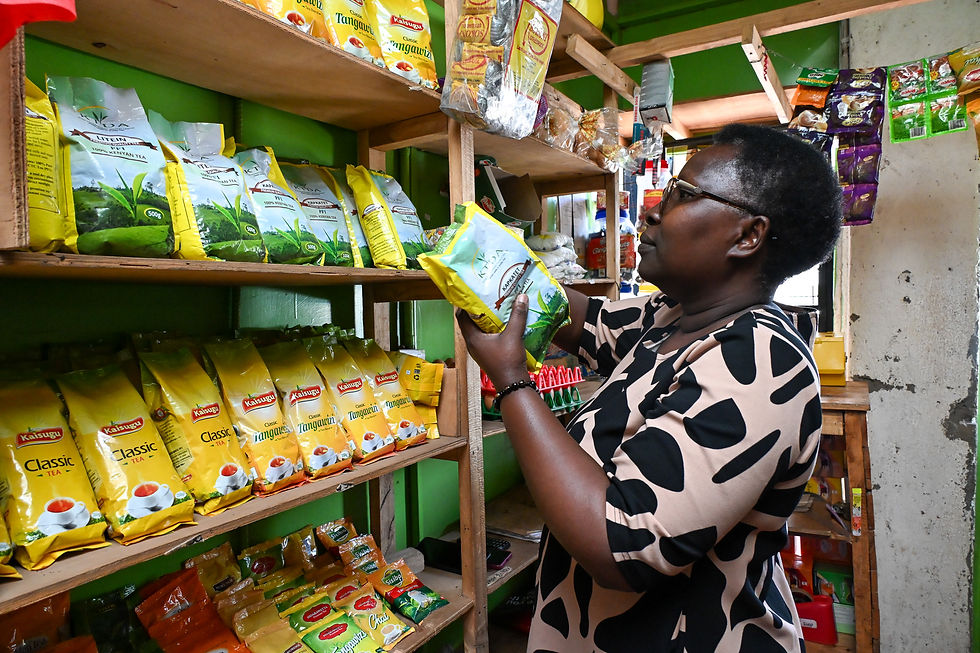
Not because she does not work hard. She works harder than most people will ever understand. But the business money and the household money have always lived in the same place. What comes in goes out. At the end of the month there is nothing left to count; not because the business is failing, but because no one has ever helped her see what is actually there.
She is not lacking capability.
What she has never had are the tools to see what she has already built.
That is who comes to Fanikisha: Kianda Foundation's business women's support program, running since 2003 across Kenya. That is who sat in a classroom in Karanjee, week after week, and at the end of the program wrote down what had changed:
"I now pay myself a salary."
The business skills module begins with one question: do you actually know what your business is earning?
For most women, the honest answer in week one is no.

By the time the Karanjee cohort finished, their answers sounded like this:
"I can differentiate between business income and my personal money."
"I know how to calculate profits for my business."
"I prepare a monthly budget for my business and my home."
"I no longer give credit facilities in my business, and the shop is well stocked."
I know that at the end of the month, I have a payslip as I now pay myself.
That last one.
A woman who was already working, who had been working for years without anyone naming the value of what she did, now pays herself a salary.
She has put a number on her own labour. She has said: this work is worth something. I am entitled to receive it.
That is a woman rewriting the story she has been telling herself about what she deserves.
"I don't only cook githeri."

"I learned new recipes in the cookery classes. I don't only cook githeri."
How many women in Kenya are cooking the same three meals, week after week, not because they lack imagination, but because no one ever gave them the time, the space, or the ingredients to try something different?
Food is livelihood. Meal preparation is one of the most time-consuming and undervalued parts of a woman's day. Learning to cook well: efficiently, creatively, confidently, has economic returns and personal ones. The Karanjee women were clear:
"I make better food for my family."

"I carry out meal preparation earlier so that I spend less time cooking."
"I used to buy snacks for the family, but now they are homemade."
One woman added her own note at the end of the feedback session.
"We need more classes on cookery."
We hear her.
"It has opened me up from the drawer."
Here is the part of Fanikisha that does not appear in most program descriptions.
The part that is hardest to explain to a funder and simplest to understand if you have lived it.

The counselling.
Every cohort receives counselling as a core part of the program. We learned, over two decades of sitting with women, that you cannot build a sustainable business while carrying a burden no one has acknowledged.
The women who come to Fanikisha are capable. Extraordinarily capable. They are also carrying weight that has nothing to do with their balance sheet. Hard marriages. Loss. The exhaustion of being the person who holds everything together while quietly coming apart inside.
The Karanjee women named what changed:
"I am self-aware."
"It has opened me up from the drawer — I can now express myself."
"I have learnt how to breathe to reduce stress and anxiety."
"I can manage my emotions better."
"I listen to my children now and respond when my anger has subsided."
And this one. This one has stayed with us.
"I am a different person. My husband gives me bus fare to attend the classes."
She came to a business training program.
She left as a different person.
Her husband, who perhaps did not understand at first, or perhaps did not care, now puts money in her hand so she can get there.
Something shifted at home because something shifted in her first.
That is the Fanikisha multiplier, playing out quietly in a household in Karanjee.
"I can now say no."
"I love myself."
"I have boundaries in my relationships."
"I can now say no."
"I can work and save for my future so that I do not depend on my children."
"I remember what I need to do, I used to forget a lot and take out my frustrations on the children ."
A woman came to Fanikisha to learn about business. She left with something that changed how she relates with her children. The stress she was carrying, the kind that accumulates when you are running a business, managing a household, navigating a marriage, and never once being asked how you actually are, was finding somewhere to go.
Her children were that somewhere.
Fanikisha gave her somewhere else to put it.
Her children got their mother back.
This is why the counselling will never be separated from the program. It is the foundation on which the business skills and the cookery and the self-care all rest.
Remove it and the building does not hold.
What She Knew All Along
60% of Fanikisha graduates double their income within six months.

Those numbers are the last thing that changes.
Before the income doubles, a woman learns to see her business clearly.
Before she sees her business clearly, she learns to see herself clearly.
Before she sees herself clearly, someone in a session asked her how she was, and waited for the real answer.
That is the sequence.
The women of Karanjee did not come to Fanikisha broken. They came capable, already working, already holding their families together with discipline and hope and very little margin for error.
What they found here was not rescue.
It was recognition.
And from recognition: a salary paid to themselves, a budget prepared, a drawer opened, a new recipe tried, a no finally said, everything else followed.

Fanikisha is part of Kianda Foundation's 65-year mission to dignify the lives of women and girls in Kenya through education, economic empowerment, and healthcare. More than 4,000 women across 90 villages in Kenya have come through the program since 2003.
If you know a woman who is ready: tell her.
→ Apply or learn more: kiandafoundation.org
Want to make it possible for more women to walk through that door?
→ Support Fanikisha: Donate

Beautiful!