


She Had a Fashion Business. She Didn't Know How to Scale It. Fanikisha Changed Everything.


Teresia sells Palazzo trousers, jiggle pants, shorts, and blouses from her shop in Karanjee, Nairobi.
She had been selling clothes for years before she walked into a Fanikisha business training session; calling people to come to her home, showing them what she had, making some money. A businesswoman by instinct and by necessity, working in the particular way that many Kenyan women in small and medium enterprises work: with capability and without the tools to make that capability fully count.
Then she heard an announcement.
There was going to be a training. Something called Fanikisha. She got interested.
I had started a business but I didn't know how to run it. But now I've been trained.
That sentence is the whole story. Not that Teresia lacked talent. Not that she lacked drive. She had been running a business. She just had not had access to the kind of structured business training that turns a surviving enterprise into a growing one.
Fanikisha: Kianda Foundation's women's economic empowerment program running since 2003 across Kenya, gave her that training. And what she built with it has gone further than she expected.
What Women's Business Training in Nairobi Actually Looks Like

For many women running small businesses in Nairobi, the gap is not ambition. It is not even hard work. It is the specific knowledge that turns a business that survives into a business that grows.
Fanikisha addresses that gap directly through business and leadership classes, cookery and nutrition training, and integrated counselling sessions that recognize what most SME training programs miss: a business is run by a whole person, not just a set of skills.
For Teresia, the business classes gave her practical tools she had never had before.
She learned to keep proper records; not roughly, not approximately, but systematically. She learned to read what her customers actually want and stock accordingly. She learned to understand the difference between revenue and profit. She learned to pay herself a salary; to name the value of her own labour and receive it.
These are not complicated lessons. They are foundational ones. And for women running informal fashion businesses, cosmetics stalls, and small enterprises across Nairobi's neighbourhoods, they are the lessons that determine whether a business stays small or starts to scale.
The Role of Counselling in Small Business Growth
One of the things that distinguishes Fanikisha from standard SME training programs in Kenya is the integration of counselling as a core, structured part of the program.
For Teresia, this was as valuable as the business training itself.
Individual counselling helped me a lot. I had some things I wanted to air out, not to be advised, but to have someone listen to me. I also learnt to create boundaries.
The ability to create and enforce boundaries; with customers, with suppliers, with family members who blur the line between personal and business finances, is one of the most practical outcomes of the counselling component. Women who exit Fanikisha with clearer boundaries make better business decisions. They stop giving unlimited credit. They separate personal money from business money. They run their enterprises with the discipline that growth requires.
This is why Kianda Foundation has always insisted that women's economic empowerment cannot be separated from women's wellbeing. The business and the person running it are not separate. Train one without supporting the other and the results plateau quickly.
From Home Sales to a Shop — and Then Online
The practical results of Teresia's Fanikisha training became visible quickly.
In December 2025, she formalized her fashion business.
In January 2026, she opened her own shop.
Not a concept. A real shop, stocked with what her customers demand, run with the
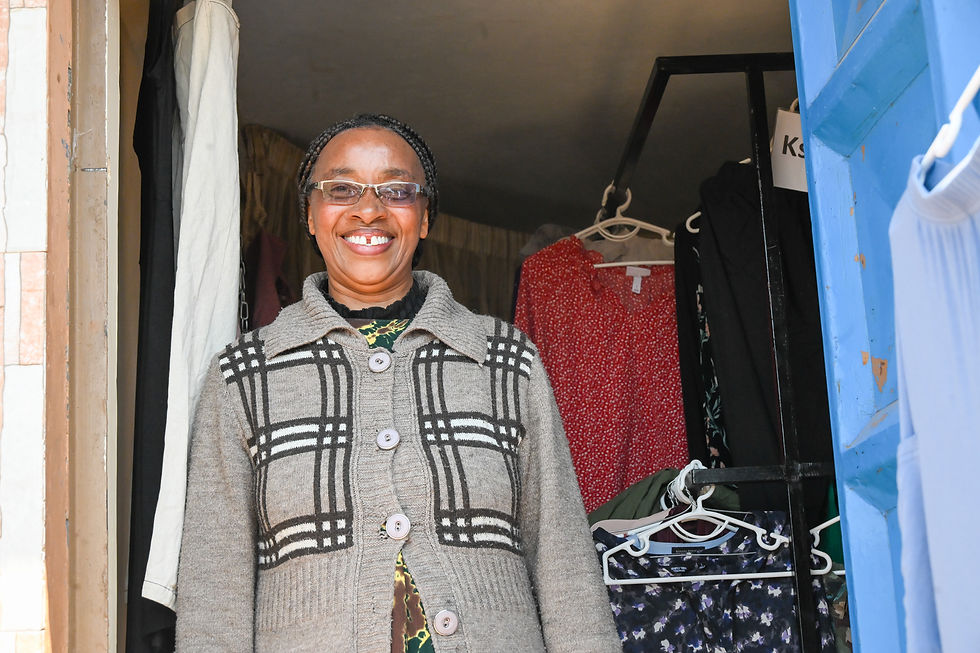
records and systems she learned to keep. Walk-in clients. Growing stock. A business that finally looked like what it had always had the potential to be.
And then it went further.
Teresia's daughter joined the business and took it online. She now sells their fashion range through TikTok, reaching customers across Kenya. A physical delivery book tracks every online order, every package dispatched to every corner of the country.
What started as a woman selling clothes from home in Karanjee is now a multi-channel fashion business with an in-store presence and a digital storefront; run by a mother and daughter team, powered by the business knowledge one of them gained in a Fanikisha session.
Digital Marketing and Small Business Growth for Women in Kenya
Teresia's story reflects a broader shift happening across Kenya's women-owned small businesses.
Digital platforms: TikTok, Instagram, Facebook Marketplace, WhatsApp Business, have lowered the barrier to reaching customers beyond the immediate neighborhood. A woman with a fashion business in Karanjee can now reach a customer in Kisumu, Mombasa, or Eldoret without a physical presence in those cities.
But digital reach without business fundamentals does not produce sustainable growth. A seller who does not keep records cannot track which products sell online versus in-store. A seller who does not separate personal and business finances cannot reinvest profit into stock. A seller who does not understand her margins cannot price correctly for delivery costs.
The women who succeed in Kenya's growing digital commerce landscape are the ones who combine digital tools with solid business foundations. Fanikisha builds the foundation. The digital tools are what women like Teresia's daughter then build on top of it.
This is the Fanikisha multiplier in its most visible form; a mother trained in business fundamentals, a daughter empowered to take those fundamentals into new markets, a family enterprise growing in ways neither of them could have predicted when Teresia first heard that announcement.
What She Said at the End
At the close of her interview, Teresia said something that has stayed with us.
When you support a woman, you have supported a whole family, even a community.
She was not quoting a development report. She was describing her own life, what Fanikisha gave her, what she built with it, what her daughter is now part of, what customers across Kenya are connected to through a delivery book and a TikTok account.
One woman supported. One family changed. One business growing.
That is not a theory. For Teresia, it is Tuesday.
Watch Teresia tell her story in her own words — in Kiswahili and English with subtitles available throughout — in the video above.
Fanikisha is Kianda Foundation's women's economic empowerment program, running since 2003 across Kenya. Business and leadership training, cookery, and counselling, because a business grows when the whole woman is supported.
Are you a woman running a small business in Nairobi or Kilifi?
Fanikisha may be for you.
→ Learn more and apply: kiandafoundation.org
Want to make it possible for more women like Teresia to access Fanikisha?
→ Support the program: Donate

Comments