


Women-Owned SMEs in Africa: The Untapped Engine of Economic Growth.
- Hariet Mwangi
- 2 minutes ago
- 6 min read

Africa’s economic story is often told through the language of GDP, foreign investment, infrastructure and large corporations. Yet a significant part of the continent’s economic activity happens on a much smaller scale, in businesses started and run by women.

From food processing and agriculture to retail, hospitality, manufacturing, professional services and technology, women-owned small and medium-sized enterprises (SMEs) are already contributing significantly to Africa’s economies.
The scale is striking. Nearly 24% of African women start their own businesses, giving Africa the highest rate of female entrepreneurial activity globally. Women own more than 40% of SMEs on the continent.
These are not marginal numbers. They represent millions of women creating income, employing others, supporting households and participating in local and regional economies. The more important question, therefore, is not whether women are contributing to Africa’s economic growth. It is how much more they could contribute if the barriers limiting their businesses were removed.
Women are already a major economic force.
Small and medium-sized enterprises are the backbone of Africa's private sector. In Sub-Saharan Africa, SMEs account for up to 90% of all businesses and approximately 38% of GDP. Women are a substantial part of this ecosystem.
More than 40% of African SMEs are owned by women, yet women entrepreneurs continue to face significantly greater barriers to capital, markets and business growth than their male counterparts.
The significance of women's businesses goes beyond their turnover.
A woman-owned business that employs three people is supporting three households. A business that grows from three employees to 20 is creating livelihoods while also generating demand for suppliers, transporters, professional services and other businesses.
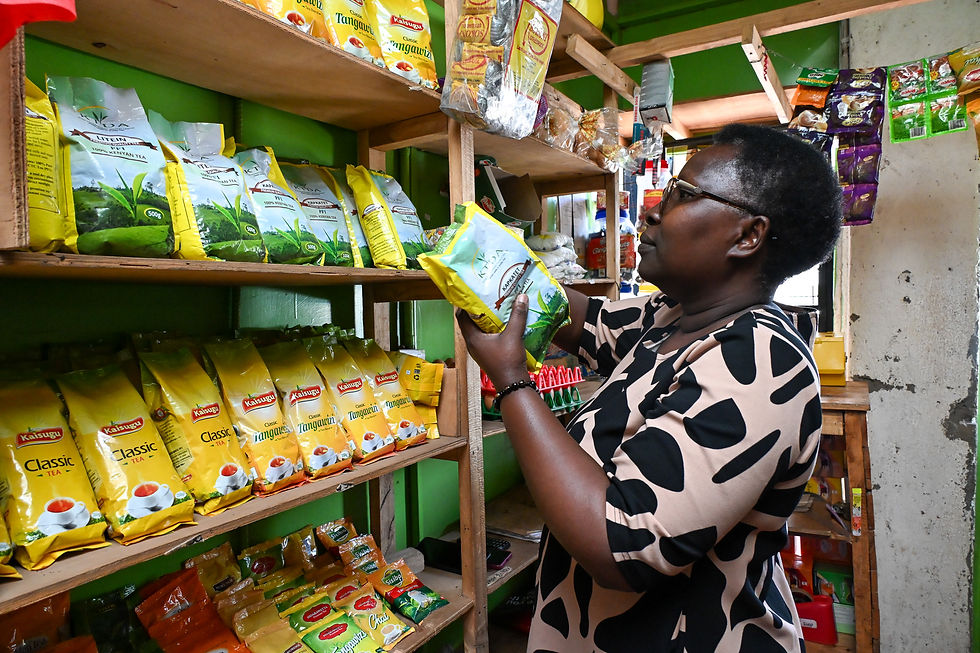
This is the multiplier effect of entrepreneurship. And there is another dimension that is particularly important in Africa: women's business income frequently supports household consumption and resilience.
World Bank research found that in Kenya, profits earned by female entrepreneurs account for an average of 65% of their household income. In Ghana, profits from women's micro-enterprises account for approximately 33% of household expenditure, while in Malawi, around 38% of women's business income goes towards daily household expenses.
When a woman-owned business grows, therefore, the impact is rarely confined to the business. It reaches the household, the community and the wider economy.
But women are operating below their economic potential.
The contradiction is difficult to ignore. Africa has one of the world's highest rates of female entrepreneurship, yet women-owned businesses frequently remain smaller, less profitable and less likely to access formal finance.
A World Bank analysis found that women-owned firms in Sub-Saharan Africa have, on average, 34% lower profits than male-owned firms, alongside lower sales and fewer employees.
The important question is why. It is not simply a question of entrepreneurial ability. It is a question of access. Women entrepreneurs are more likely to operate in the informal economy. The World Bank estimates that 63% of women in Africa's non-agricultural labour force are self-employed in the informal sector.
Informality can limit access to credit, larger contracts, business networks, insurance and other opportunities required for growth. A woman may have a viable business, loyal customers and years of experience,

but without formal records, collateral or a credit history, the business can remain invisible to conventional financial institutions. And this is where the financing gap becomes particularly important.
The US$42 billion question
Women-owned SMEs in Sub-Saharan Africa face an estimated US$42 billion financing gap. Think about that number. US$42 billion is not simply money that women entrepreneurs do not have. It represents businesses that are potentially unable to purchase equipment, increase production, hire employees, enter new markets or take advantage of opportunities because capital is unavailable or inaccessible.
The financing gap is not only about the amount of money available. It is also about the terms. Recent IFC data shows that in 2024, women-owned SMEs represented 27% of the number of SME loans in its client financial institutions, but only 19% of outstanding SME loan volumes by value. The average loan to a women-owned SME was also 28% smaller than the average SME loan. And yet, the data challenges the perception that women entrepreneurs are inherently riskier borrowers.
In 2024, women-owned SMEs in IFC client portfolios had a 3.6% non-performing loan ratio, compared with 3.8% for the overall SME portfolio.
In simple terms: women-owned businesses were, in this dataset, performing at least as well as — and slightly better than — the broader SME portfolio when it came to loan repayment. That should make us rethink the way capital is allocated.
Venture capital tells a similar story
The financing challenge becomes even more pronounced when we look at high-growth businesses. In 2021, startups founded or led by women received less than 7% of all funding raised by African startups.
This matters because access to investment can determine whether a business remains small or becomes a significant employer and market player.
If women are starting businesses at a rate of 24%, but women-led startups receive less than 7% of startup funding, there is a clear disconnect between entrepreneurial participation and capital allocation. The opportunity cost is significant.

Every business that cannot expand represents potential jobs that are not created, products that are not developed, markets that are not entered and tax revenue that is not generated.
Finance alone is not enough
Capital must be accompanied by the skills and systems needed to use it effectively.
Women entrepreneurs need access to financial literacy, digital skills, business management, mentorship, market linkages and networks. They need support to move from running a small business to building an enterprise capable of creating jobs and generating sustainable revenue.
This distinction matters.
Starting a business is one achievement. Building a profitable business that can employ others, enter larger markets and survive economic shocks is another.
The barriers also extend beyond the business environment. Women continue to face unequal access to productive assets and technology, as well as social and household responsibilities that can limit the time and resources available for enterprise growth.
What happens when we address these barriers?
The economic case for action is compelling. The World Bank estimates that if gender gaps in employment were closed, global GDP per capita could be almost 20% higher in the long run.
At the business level, the opportunity is equally significant. Closing the gender gap in business performance means more profitable enterprises, more employees, stronger supply chains and increased household incomes.
It means a woman-owned catering company moving from five employees to 20. A small manufacturer investing in machinery and increasing production. A farmer moving from selling raw produce to processing and supplying larger markets.
These are not simply individual success stories. They represent economic activity that multiplies across communities.
In 2024, IFC financial institution clients provided 1.3 million loans to women-owned SMEs worth US$52 billion globally. The scale demonstrates that women-owned businesses represent a substantial and investable market.
From entrepreneurship to economic transformation
Africa does not have a shortage of entrepreneurial women. What it needs is an ecosystem that allows more of those women to scale. That means closing the financing gap, improving access to markets, strengthening digital and business skills, expanding mentorship and networks, and creating policies and financial products that reflect the realities of women-owned enterprises. For organisations working in women's economic empowerment, this should change how we measure impact.

It should not be enough to ask how many women completed a training programme or started a business.
We should also ask:
How many increased their revenue?
How many created jobs?
How many accessed finance?
How many moved into new markets?
How many businesses are still operating and growing five years later?
Because when women-owned SMEs grow, the benefits extend beyond the entrepreneur. Businesses grow. Jobs are created. Household incomes increase. Communities become more resilient. And economies become more productive.
The opportunity is already in front of us. Africa's women are building businesses at remarkable rates. The next step is to ensure that they have the capital, skills, markets and support required to build those businesses into the engines of growth that Africa needs.
Investing in women-owned SMEs is not simply an investment in women. It is an investment in Africa's economic future.
International Finance Corporation (IFC) — She Wins Africa: Unlocking the Potential of Women-led Startups in Africa. Read the IFC report
World Bank — Eliminating Gender Disparities in Business Performance in Africa: Supporting Women-Owned Firms. Read the World Bank report
International Finance Corporation (IFC) — Why Investing in Women-Owned SMEs is Smart Business, 2026. Read the IFC analysis
International Finance Corporation (IFC) — MSME Finance. View IFC's MSME Finance data
World Bank — International Women's Day 2025: Women’s Economic Empowerment. Read the World Bank analysis


Comments